Thursday, 17 March 2016

Working for the Soul..


…matter is physical exuberance, ennobling contact, virile effort and the joy of growth. It attracts, renews, unites and flowers. By matter we are nourished, lifted up, linked to everything else, invaded by life…it contains the spur or the allurement to be our accomplice towards heightened being…
— Theilhard de Chardin

 I started carving with soap as material as it was something which is available in my immediate surrounding. I also wanted to explore on this "routine" aspect as compared to the sensational emotions felt on the beach. I wanted to create a bridge between the Retreat (escapism) and the Home (domesticality) for they both form part of my reality. There is a balance that is maintained for my well-being. 
For me, the act of carving is a form of art therapy. It is a reductivist/subtractive  method where I get to surrender to the creative process. There is a form of vitality in sculpting: the shaping, the forming, the building and the growing. The shapes that emerge are appealing and soothing. While the hand is in full action, self-awareness is enhanced as it becomes more physical. I am reminded of the words of Vincent Van Gogh here who relates "the art produced by man's hands" to the "working of the soul": 
"Art, although produced by man's hands, is something not created by hands alone, but something which wells up from a deeper source of our soul.. My sympathies in the literary as well as in the artistic are drawn more strongly to those artists in whom I see most the working of the soul."
My approach to my work is entirely organic, in response to both emotion and material. I now choose to think about another period of time as I work on. My objects; my collections belongs to another place. The work, produced in the studio, triggers memories from the past. However, the (man-made) material belong to the home/the studio. It is a product; it has a function. By de-contextualising the soap, it now exists in an artistic form. 
As material, soap is soft and malleable. The shape easily comes out and texture is easily formed. There is a fragility associated with the material that I like and I also like the way this material is to be handled with much care. They are also comforting to the hand.
There is a form of ritual going on that is most appealing: something is being transformed in the act of making. In the process, something grows out and unfolds itself, changing from the initial response. There is yet another ritual to complete the ritualistic/ceremonial circle.
I would like to bring these carvings to the sea with me. I would like to place them into the waves to share them with my place of retreat. I would like to trigger the initial function of the soap which is to disintegrate at the contact with water to see what can happen. As soap is an ephemeral material, the swaying actions of the waves can either wash away its surfaces and carve in new forms or break the fragile structures to re-model the sculptures as with the fragmented shells. The displacement from the home to the place where all this started is like a pilgrimage and in a way it can end up as an offering to my "home"; the place where I belong but also the "home" which is the world; and I would be carrying my sense of the home and my love for it to another country where at the end I would be exhibiting my work at the Gallery. I am quite thrilled by this prospect for as I see this act as a heightened form of sharing...


Wednesday, 16 March 2016

More Drawings..


Breathing Space: From Art Therapy To Spirituality


"Between stimulus and response there is a space. In that space is our power to choose our response. In our response lies our growth and our freedom." - Victor Frankl  

 “The little things? The little moments?
  They aren’t little.”   
– Jon Kabat-Zinn       

I have often come across Art Therapy treatments concerning the investigation on the feeling of "the now". This is something I found which is related to "tuning in" of the mind which I also link to a form of meditation.
Mindfulness-Based Stress Reduction (MBSR) and Mindfulness-Based Cognitive Therapy (MBCT) are techniques have been shown to reduce symptoms of stress, anxiety, and depression.
Mindfulness may mean many things to different people. According to some Art Therapists, mindfulness as a mind-body technique that allows us to increase awareness of our thoughts, feelings, and bodily sensations. When we increase awareness of the present moment, we are able to relax our constant judgments and find more pleasure in “what is.”
 Art Therapy Technique:3 Minute Breathing Space
1) Acknowledging
 Bring yourself into the present moment by deliberately adopting a dignified posture. Then ask: ‘What’s going on with me at this moment? What thoughts, feelings and body sensations am I experiencing right now?
You could put your inner experience into words. For example, say in your mind, ‘A feeling of anger is arising’ or ‘self-critical thoughts are here’ or ‘my stomach is clenched and tense.’  
2) Gathering
Gently bring your full attention to the breathing. Experience fully each in-breath and each out-breath as they follow one after the other.  It may help to note at the back of your mind ‘breathing in…breathing out’, or to count the breaths. Let the breath function as an anchor to bring you into the present and to help you tune into a state of awareness and stillness.
3) Expanding
Expand your awareness around the breathing to the whole body, and the space it takes up, as if your whole body is breathing. Especially take the breath to any discomfort, tension or resistance you experience, ‘breathing in’ to the sensations.  While breathing out, allow a sense of softening, opening, letting go. You can also say to yourself ‘It’s ok to feel whatever I’m feeling.’ Include a sense of the space around you too. Hold everything in awareness. As best you can, bring this expanded awareness into the next moments of your day.
You might like to start using the three-minute breathing space in moments of stress, when you are troubled in thoughts or feelings. You can use it to step out of automatic pilot; to reconnect with the present moment and your own inner wisdom.

I think to absorb, smell, feel, touch, think about, see, taste, hear, and appreciate- already we are deep in the process/making. The first part of the process is involved with Remembering and Embodying while the second part is involved with Modelling and Sharing. I am experimenting on the collaborative process /sharing with the environment right now where my carved soaps will be taken to the beach and immersed with the waves. I am planning that as a performance but also a film. I would also be taking notes.
In his book Trust the Process: An Artist’s Guide To Letting Go, art therapist Shaun McNiff devotes a chapter to creative collaborations with environment and nature. McNiff’s own work draws deeply from observations and times spent in nature. He also encourages readers to explore directly making art involving nature. Rocks, leaves, sticks, mud, and grass are all examples of nature’s raw art materials. McNiff writes:
“The deep satisfaction gained from this type of environmental art is related to an absence of possessiveness and self-consciousness. There is no thought given to taking something home with us. The creative act is pursued solely for its own sake within an ephemeral context. The virtues experienced by working directly with nature help us to create in a similar way when we are in the studio.” 

Many cultures (including European, Native American, African and Pacific Islands) believe that nature is alive and there is a deep sense of mystery and enchantment which  has to be respected and venerated. The plants and animals offer both teachings and nourishment to humans. We are part of nature. My culture (being of Indian Origin-Hinduism) considers nature as the mother from which everything originates. As  being part of it, we are to respect our ties and it is only through this connection that we are able to enjoy spiritual happiness.
 
Hinduism has often been coined as a "environmental friendly" religion. Hindus regard everything around them as pervaded by a subtle divine presence, may it be rivers, mountains, lakes, animals, flora, the mineral world, as well as the stars and planets. It is so because the Divine reality is present as Prana/Shakti energy, power, in every electron, particle, atom, cell and in every manifestation of matter. It is its very fabric. Just like the sparks of a fire are of the same essence as the fire they were issued forth from, so is the entire creation, of the same essence as the Divine. Just as Hindus greet each other saying "Namaste", which means: I recognize and salute the Divine within you, so do they recognize the same Divine essence, in all around them.


Ayurveda, the science of life, which is a complete health and medicine system based on nature and its regenerating forces. Then we have Vastu Shastra, upon which the now well-known Feng Shui is based. Vastu, teaches us how to place and build dwellings, according to the environment it is situated in. It is done in such a way that the surroundings are not damaged by the building's presence, and so that all the natural energies are flowing uninterrupted and freely, providing comfort, peace and prosperity for the dwellers.

Another facet of Hinduism's environmental concern is to do with food is a very physical example: vegetarianism. Typically, Hindu social thought has always included an ecological dimension. Socialism and liberalism do not have this dimension, they can at best annex it. But it is an organic part of Hindu dharma.

(source: Hinduism and Environment - hinduchatzone.com).

Throughout the long history of India, Hindus have shared a fascination with, and respect for, Nature and animals. 

This attitude went beyond the usefulness. It had to do with reverence for all of God's creation. Our ancestors worshipped trees, rivers, birds and stones and connected to the universal principle through Shiva. As we are growing more materialistic, we are losing this connection. Our ancestors saw Nature as being a manifestation of God. There was, therefore, a gratitude towards nature. http://www.hinduwisdom.info/Nature_Worship.htm

Thinking about "my gathering"

There is an acute sense of awareness when I go to gather up my ideas.. I like walking: I get to get over stressing thoughts and a calmness gets to install in. However, walking on the beach is more intense. Overwhelming emotions comes in. I am aware of the wonder and grace which is so powerful, so intense as compared to my pains and problems. Everything eventually comes to a still. Being in the "right now" is the only thing that matters. 
This "moment" is the one before me.  It is the one I can experience and transform. This moment I can choose to be right where I am in the fullest possible sense. And I can breathe to open my senses so that I can feel myself as a small part of the moment in preparation for the depth of possibility it holds.  I can expand my listening to hear the sounds of the waves sharing the moment with me. There is something going on: nature is whispering something important to me. I can expand my moment to the landscape of which I am a detail and find inspiration in the land, air, water, little creatures, shells,leftover of the sea,decayed weeds, twigs and plants around me. I am  part of this process too. I feel this must be some form spiritual practice that I am trying to describe; a collaborative process where I get to be connected with other species in a special way while a slowing down process installs in. The space, the time and the mind become ONE.
I listen to nature for its deeper message; I think It tells me to REMEMBER, for soon enough, as I will be orienting my steps towards another reality, I would only have my memories with me and a nostalgia of what I felt in the past.
The art that I would be creating would be from another reality; the place would be different as would be my perception then. However, I choose to create at that place only as the power of the inspiration felt have been deeply absorbed. The studio is also a place where I belong; it is full with possibility and will enliven ideas from the subconscious. There would be a regeneration process; linked with the domestic aspects of my routine life. There would be a creative attempt to renew these felt emotions, to adapt myself and to re-build on  the familiar in new forms.
What I feel from my making is like meeting a challenge: to expand from what is shifting and changing and to re-orient from fragments. The possibilities here becomes unlimited as one think to grasp on the dynamic rhythms and fragmented patterns of the shells, sharing the treasure within ..
 
Ideas From :
The Native Mind and the Cultural Construction of Nature By Scott Atran and Douglas L. Medin and
Folkbiology  Edited by Douglas L. Medin and Scott Atran

Saturday, 27 February 2016

Mary’s Shell, Cleveleys, Lancashire Fylde Coast

Mary’s Shell, Cleveleys, Lancashire Fylde Coast

Patterns in Nature

patterns-in-nature-02Types of pattern

(https://en.wikipedia.org/wiki/Patterns_in_nature)

Symmetry

Symmetry is pervasive in living things. Animals mainly have bilateral or mirror symmetry, as do the leaves of plants and some flowers such as orchids. Plants often have radial or rotational symmetry, as do many flowers and some groups of animals such as sea anemones. Fivefold symmetry is found in the echinoderms, the group that includes starfish, sea urchins, and sea lilies.
Among non-living things, snowflakes have striking sixfold symmetry: each flake is unique, its structure forming a record of the varying conditions during its crystallisation, with nearly the same pattern of growth on each of its six arms. Crystals in general have a variety of symmetries and crystal habits; they can be cubic or octahedral, but true crystals cannot have fivefold symmetry (unlike quasicrystals). Rotational symmetry is found at different scales among non-living things including the crown-shaped splash pattern formed when a drop falls into a pond, and both the spheroidal shape and rings of a planet like Saturn.
Symmetry has a variety of causes. Radial symmetry suits organisms like sea anemones whose adults do not move: food and threats may arrive from any direction. But animals that move in one direction necessarily have upper and lower sides, head and tail ends, and therefore a left and a right. The head becomes specialised with a mouth and sense organs (cephalisation), and the body becomes bilaterally symmetric (though internal organs need not be). More puzzling is the reason for the fivefold (pentaradiate) symmetry of the echinoderms. Early echinoderms were bilaterally symmetrical, as their larvae still are. Sumrall and Wray argue that the loss of the old symmetry had both developmental and ecological causes.

Trees, fractals

Fractals are infinitely self-similar, iterated mathematical constructs having fractal dimension. Infinite iteration is not possible in nature so all 'fractal' patterns are only approximate. For example, the leaves of ferns and umbellifers (Apiaceae) are only self-similar (pinnate) to 2, 3 or 4 levels. Fern-like growth patterns occur in plants and in animals including bryozoa, corals, hydrozoa like the air fern, Sertularia argentea, and in non-living things, notably electrical discharges. Lindenmayer system fractals can model different patterns of tree growth by varying a small number of parameters including branching angle, distance between nodes or branch points (internode length), and number of branches per branch point.
Fractal-like patterns occur widely in nature, in phenomena as diverse as clouds, river networks, geologic fault lines, mountains, coastlines,animal coloration, snow flakes, crystals,blood vessel branching,and ocean waves.

Spirals

Further information: phyllotaxis
Spirals are common in plants and in some animals, notably molluscs. For example, in the nautilus, a cephalopod mollusc, each chamber of its shell is an approximate copy of the next one, scaled by a constant factor and arranged in a logarithmic spiral. Given a modern understanding of fractals, a growth spiral can be seen as a special case of self-similarity.
Plant spirals can be seen in phyllotaxis, the arrangement of leaves on a stem, and in the arrangement (parastichy) of other parts as in composite flower heads and seed heads like the sunflower or fruit structures like the pineapple and snake fruit, as well as in the pattern of scales in pine cones, where multiple spirals run both clockwise and anticlockwise. These arrangements have explanations at different levels – mathematics, physics, chemistry, biology – each individually correct, but all necessary together.Phyllotaxis spirals can be generated mathematically from Fibonacci ratios: the Fibonacci sequence runs 1, 1, 2, 3, 5, 8, 13... (each subsequent number being the sum of the two preceding ones). For example, when leaves alternate up a stem, one rotation of the spiral touches two leaves, so the pattern or ratio is 1/2. In hazel the ratio is 1/3; in apricot it is 2/5; in pear it is 3/8; in almond it is 5/13. In disc phyllotaxis as in the sunflower and daisy, the florets are arranged in Fermat's spiral with Fibonacci numbering, at least when the flowerhead is mature so all the elements are the same size. Fibonacci ratios approximate the golden angle, 137.508°, which governs the curvature of Fermat's spiral.
From the point of view of physics, spirals are lowest-energy configurationswhich emerge spontaneously through self-organizing processes in dynamic systems. From the point of view of chemistry, a spiral can be generated by a reaction-diffusion process, involving both activation and inhibition. Phyllotaxis is controlled by proteins that manipulate the concentration of the plant hormone auxin, which activates meristem growth, alongside other mechanisms to control the relative angle of buds around the stem. From a biological perspective, arranging leaves as far apart as possible in any given space is favoured by natural selection as it maximises access to resources, especially sunlight for photosynthesis.

Chaos, flow, meanders[

In mathematics, a dynamical system is chaotic if it is (highly) sensitive to initial conditions (the so-called "butterfly effect"), which requires the mathematical properties of topological mixing and dense periodic orbits.
Alongside fractals, chaos theory ranks as an essentially universal influence on patterns in nature. There is a relationship between chaos and fractals—the strange attractors in chaotic systems have a fractal dimension. Some cellular automata, simple sets of mathematical rules that generate patterns, have chaotic behaviour, notably Stephen Wolfram's Rule 30.
Vortex streets are zigzagging patterns of whirling vortices created by the unsteady separation of flow of a fluid, most often air or water, over obstructing objects. Smooth (laminar) flow starts to break up when the size of the obstruction or the velocity of the flow become large enough compared to the viscosity of the fluid.
Meanders are sinuous bends in rivers or other channels, which form as a fluid, most often water, flows around bends. As soon as the path is slightly curved, the size and curvature of each loop increases as helical flow drags material like sand and gravel across the river to the inside of the bend. The outside of the loop is left clean and unprotected, so erosion accelerates, further increasing the meandering in a powerful positive feedback loop.

Waves, dunes

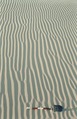
Waves are disturbances that carry energy as they move. Mechanical waves propagate through a medium – air or water, making it oscillate as they pass by. Wind waves are sea surface waves that create the characteristic chaotic pattern of any large body of water, though their statistical behaviour can be predicted with wind wave models. As waves in water or wind pass over sand, they create patterns of ripples. When winds blow over large bodies of sand, they create dunes, sometimes in extensive dune fields as in the Taklamakan desert. Dunes may form a range of patterns including crescents, very long straight lines, stars, domes, parabolas, and longitudinal or Seif ('sword') shapes.
Barchans or crescent dunes are produced by wind acting on desert sand; the two horns of the crescent and the slip face point downwind. Sand blows over the upwind face, which stands at about 15 degrees from the horizontal, and falls on to the slip face, where it accumulates up to the angle of repose of the sand, which is about 35 degrees. When the slip face exceeds the angle of repose, the sand avalanches, which is a nonlinear behaviour: the addition of many small amounts of sand causes nothing much to happen, but then the addition of a further small amount suddenly causes a large amount to avalanche. Apart from this nonlinearity, barchans behave rather like solitary waves.

Bubbles, foam

A soap bubble forms a sphere, a surface with minimal area — the smallest possible surface area for the volume enclosed. Two bubbles together form a more complex shape: the outer surfaces of both bubbles are spherical; these surfaces are joined by a third spherical surface as the smaller bubble bulges slightly into the larger one.
A foam is a mass of bubbles; foams of different materials occur in nature. Foams composed of soap films obey Plateau's laws, which require three soap films to meet at each edge at 120° and four soap edges to meet at each vertex at the tetrahedral angle of about 109.5°. Plateau's laws further require films to be smooth and continuous, and to have a constant average curvature at every point. For example, a film may remain nearly flat on average by being curved up in one direction (say, left to right) while being curved downwards in another direction (say, front to back). Structures with minimal surfaces can be used as tents. Lord Kelvin identified the problem of the most efficient way to pack cells of equal volume as a foam in 1887; his solution uses just one solid, the bitruncated cubic honeycomb with very slightly curved faces to meet Plateau's laws. No better solution was found until 1993 when Denis Weaire and Robert Phelan proposed the Weaire–Phelan structure; the Beijing National Aquatics Center adapted the structure for their outer wall in the 2008 Summer Olympics.
At the scale of living cells, foam patterns are common; radiolarians, sponge spicules, silicoflagellate exoskeletons and the calcite skeleton of a sea urchin, Cidaris rugosa, all resemble mineral casts of Plateau foam boundaries.The skeleton of the Radiolarian, Aulonia hexagona, a beautiful marine form drawn by Haeckel, looks as if it is a sphere composed wholly of hexagons, but this is mathematically impossible. The Euler characteristic states that for any convex polyhedron, the number of faces plus the number of vertices (corners) equals the number of edges plus two. A result of this formula is that any closed polyhedron of hexagons has to include exactly 12 pentagons, like a soccer ball, Buckminster Fuller geodesic dome, or fullerene molecule. This can be visualised by noting that a mesh of hexagons is flat like a sheet of chicken wire, but each pentagon that is added forces the mesh to bend (there are fewer corners, so the mesh is pulled in).

Tessellations

Tessellations are patterns formed by repeating tiles all over a flat surface. There are 17 wallpaper groups of tilings. While common in art and design, exactly repeating tilings are less easy to find in living things. The cells in the paper nests of social wasps, and the wax cells in honeycomb built by honey bees are well-known examples. Among animals, bony fish, reptiles or the pangolin, or fruits like the Salak are protected by overlapping scales or osteoderms, these form more-or-less exactly repeating units, though often the scales in fact vary continuously in size. Among flowers, the Snake's Head Fritillary, Fritillaria meleagris, have a tessellated chequerboard pattern on their petals. The structures of minerals provide good examples of regularly repeating three-dimensional arrays. Despite the hundreds of thousands of known minerals, there are rather few possible types of arrangement of atoms in a crystal, defined by crystal structure, crystal system, and point group; for example, there are exactly 14 Bravais lattices for the 7 lattice systems in three-dimensional space.

Cracks

Cracks are linear openings that form in materials to relieve stress. When an elastic material stretches or shrinks uniformly, it eventually reaches its breaking strength and then fails suddenly in all directions, creating cracks with 120 degree joints, so three cracks meet at a node. Conversely, when an inelastic material fails, straight cracks form to relieve the stress. Further stress in the same direction would then simply open the existing cracks; stress at right angles can create new cracks, at 90 degrees to the old ones. Thus the pattern of cracks indicates whether the material is elastic or not. In a tough fibrous material like oak tree bark, cracks form to relieve stress as usual, but they do not grow long as their growth is interrupted by bundles of strong elastic fibres. Since each species of tree has its own structure at the levels of cell and of molecules, each has its own pattern of splitting in its bark.

Spots, stripes

Leopards and ladybirds are spotted; angelfish and zebras are striped. These patterns have an evolutionary explanation: they have functions which increase the chances that the offspring of the patterned animal will survive to reproduce. One function of animal patterns is camouflage; for instance, a leopard that is harder to see catches more prey. Another function is signalling — for instance, a ladybird is less likely to be attacked by predatory birds that hunt by sight, if it has bold warning colours, and is also distastefully bitter or poisonous, or mimics other distasteful insects. A young bird may see a warning patterned insect like a ladybird and try to eat it, but it will only do this once; very soon it will spit out the bitter insect; the other ladybirds in the area will remain unmolested. The young leopards and ladybirds, inheriting genes that somehow create spottedness, survive. But while these evolutionary and functional arguments explain why these animals need their patterns, they do not explain how the patterns are formed.

Pattern formation

Alan Turing,and later the mathematical biologist James Murray, described a mechanism that spontaneously creates spotted or striped patterns: a reaction-diffusion system.The cells of a young organism have genes that can be switched on by a chemical signal, a morphogen, resulting in the growth of a certain type of structure, say a darkly pigmented patch of skin. If the morphogen is present everywhere, the result is an even pigmentation, as in a black leopard. But if it is unevenly distributed, spots or stripes can result. Turing suggested that there could be feedback control of the production of the morphogen itself. This could cause continuous fluctuations in the amount of morphogen as it diffused around the body. A second mechanism is needed to create standing wave patterns (to result in spots or stripes): an inhibitor chemical that switches off production of the morphogen, and that itself diffuses through the body more quickly than the morphogen, resulting in an activator-inhibitor scheme. The Belousov–Zhabotinsky reaction is a non-biological example of this kind of scheme, a chemical oscillator.
Later research has managed to create convincing models of patterns as diverse as zebra stripes, giraffe blotches, jaguar spots (medium-dark patches surrounded by dark broken rings) and ladybird shell patterns (different geometrical layouts of spots and stripes, see illustrations). Richard Prum's activation-inhibition models, developed from Turing's work, use six variables to account for the observed range of nine basic within-feather pigmentation patterns, from the simplest, a central pigment patch, via concentric patches, bars, chevrons, eye spot, pair of central spots, rows of paired spots and an array of dots. More elaborate models simulate complex feather patterns in the Guinea fowl, Numida meleagris, in which the individual feathers feature transitions from bars at the base to an array of dots at the far (distal) end. These require an oscillation created by two inhibiting signals, with interactions in both space and time.
Patterns can form for other reasons in the vegetated landscape of tiger bush and fir waves.Tiger bush stripes occur on arid slopes where plant growth is limited by rainfall. Each roughly horizontal stripe of vegetation effectively collects the rainwater from the bare zone immediately above it. Fir waves occur in forests on mountain slopes after wind disturbance, during regeneration. When trees fall, the trees that they had sheltered become exposed and are in turn more likely to be damaged, so gaps tend to expand downwind. Meanwhile, on the windward side, young trees grow, protected by the wind shadow of the remaining tall trees.Natural patterns are sometimes formed by animals, as in the Mima mounds of the Northwestern United States and some other areas, which appear to be created over many years by the burrowing activities of pocket gophers.
In permafrost soils with an active upper layer subject to annual freeze and thaw, patterned ground can form, creating circles, nets, ice wedge polygons, steps, and stripes. Thermal contraction causes shrinkage cracks to form; in a thaw, water fills the cracks, expanding to form ice when next frozen, and widening the cracks into wedges. These cracks may join up to form polygons and other shapes.