Tuesday, 5 May 2015

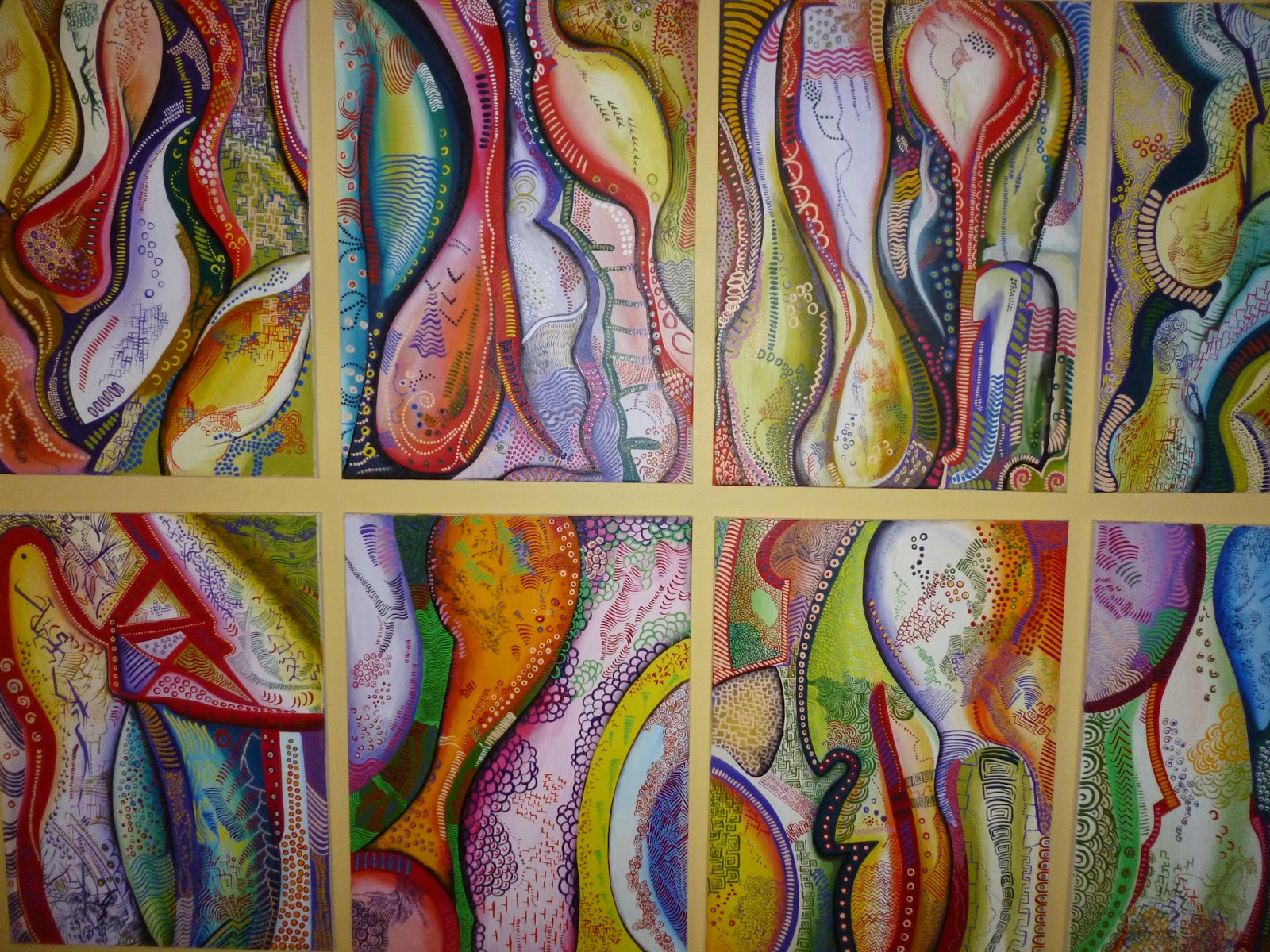
Task Three: Excitedly Finished; Enjoyed the puzzle..

Peer Review:28th May 2015- group Hangout Group Two.

Hello all,
I found this particular hangout with you all really important for according to me; we were able to drew out from each others' experiences and what came out were unexpected ideas and most welcoming advice. As for myself, I had been presently "meditating" on my original objectives while I started making Task Three and talking about them made me take on important decisions to this work. Thank you.
Rosi:
Your recent slides which you sent had a lighter quality and in a way;as they were simple in a sense; to me they created an instant impact, connection and delight . I could sense the journey to your being there as we discussed. I also enjoyed your prior works too as I am fascinated by how you were developing on the idea of maps in a very personal and unique way. These first works had a deeper quality too. We also discussed about "Digital Art" as compared to other art forms and the apprehension of choosing something where you have to work hard to learn and master the technique. However, I think that the role of the contemporary artist is to keep on experimenting and searching( and of course using the tools of the present) . Sometimes it is best to come out from what we had been engrossed on for a long period of time to offer a fresh perspective on out thought patterns. I can totally understand the nostalgia behind your former painting technique; and also I think what you are presently doing is subconsciously thinking over painting by distancing yourself from it; as isn't your digital works not paintings after all?..
Debjani:
I am always delighted by how you are able to find inventive solutions to your paper-cuts ideas. I feel the hard work behind and also the issues you may have been confronted to as facing risks and overcoming the "comfort zone". Haven't we all matured from this course? Your ideas are now more towards fusing/merging as I see you are now turning towards performance and you are engaged in another level of learning with the grouping of the different elements/techniques. I also feel that you are more confident about what you are doing and you are pursuing your field of interest by working on a theme and developing on something which only you can do best (optimising on your capacity). I can relate to your idea of lost cultural heritage as it forms part of my concern too and as discussed; I found the ideas about globalisation/"westernising" of our cultures interesting and inspiring.
Iain:
I see such positive change in your work too as your ideas are turning more and more toward the personal; the intimate and even the self. In a way; to me; I now feel that the connection that you now share with your work is deeper/stronger as compared to what you were engaged with before. You have shifted from "pleasing the audience" to "pleasing yourself"; which is also one of my primary objectives. In doing so; your works shows a "rawness"- not in terms of technique (as you are expertly professional on that, no question about it!!), but in terms of emotions which immediately strikes on.       

Sunday, 19 April 2015

Shelf Paintings.

Katherine Bradford, Phoenix, 2014 (courtesy of Arts+Leisure)Katherine Bradford, Phoenix, 2014.
Katherine Bradford advances that her ideas of Shelf Paintings originated by noticing that some mayor part of her subject matter always seemed to be focused on the bottom part of her works. She then thought of "removing" these out hence the idea of Shelf Paintings.
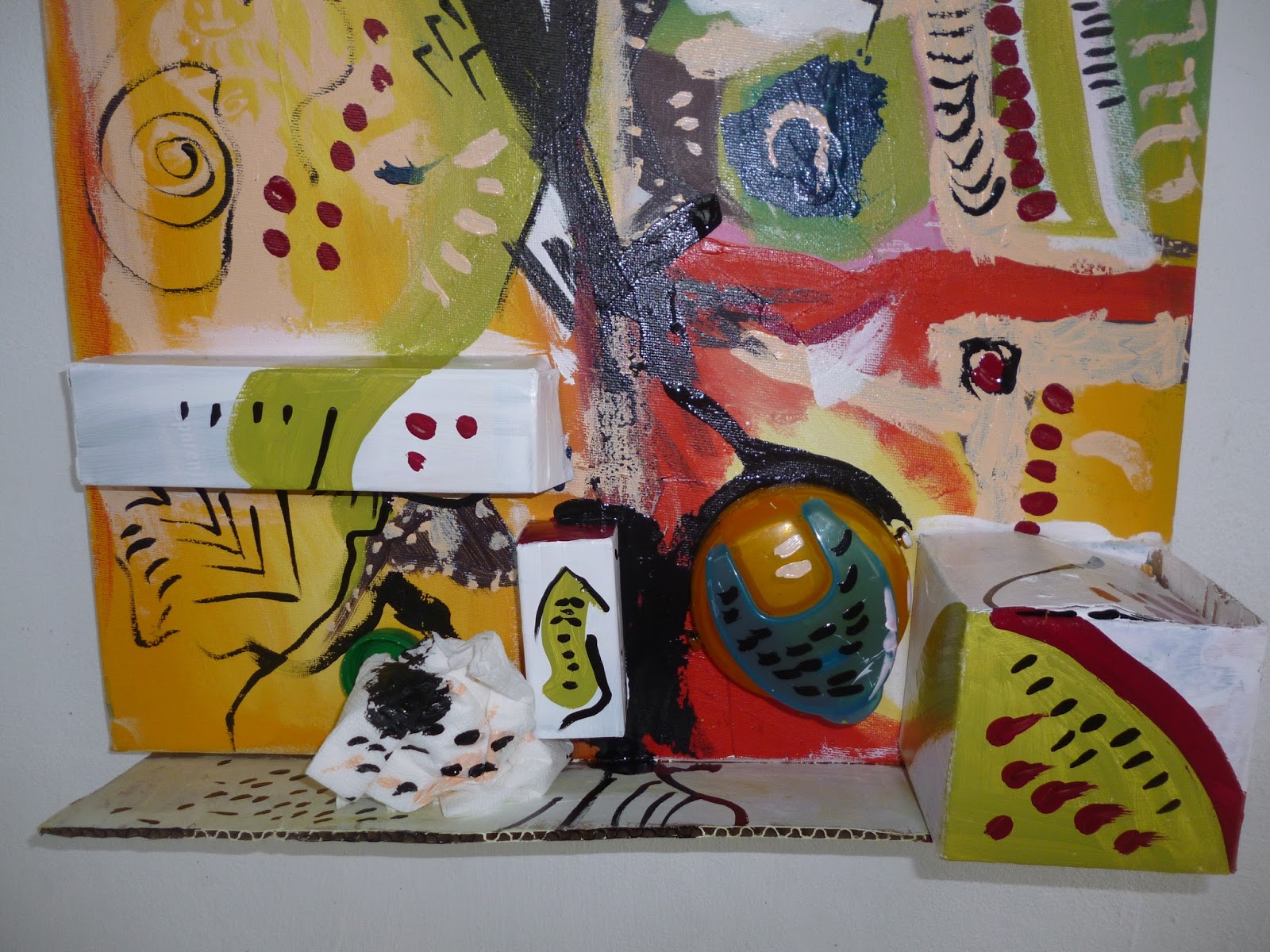
Discovering her was like a breath of fresh air, all I wanted to do next was to try one too.Play of boundaries again: Is it a painting?; Is it a sculpture?; Is it a relief Sculpture?; Is it a Shelf?..
Reading about her stunningly simple idea; I started furiously thinking about how a painting can "CONTAIN" elements and the psychological implication behind "collecting" and treasuring objects: linking with memory, making meaning and attachment. One article describes her work in this way: "Each painting from the beginning of the show to the end is thoroughly felt in three dimensions, offering detail from all views with front and center being the ultimate read. This gives the work a performative feel with shelf as stage and objects as actors. The best seats may be front and center, but there are also interesting and complex views from stage left, and the orchestra pit. Even as we are the viewers, however, the paintings with their frontal protrusions seem to be viewing, and reflecting upon themselves." http://www.paintingisdead.com/katherine-bradford-@-arts-leisure.html
My Shelf painting was an important activity as I shifted my interest from the process of intuitive painting to the discovery and integration new elements/objects and information. My process was hence different in the sense that I started by giving up the way I used to do my paintings to be fully engrossed in another creative process whereby creating new patterns of perception and a shift from the routine, the repetitive and the persistent. I found out however that as I engaged in a reflexive dialogue with my work, I did not shared the same interest as Katherine; hence I was accomodating new visions and looking beyond what I already know to the unknown. I was also fully satisfied by the personal response and its impactual feel.


Friday, 17 April 2015

My Painting Sketches: Extracts from my Sketchbook.

The act of painting has a pulse; it is something that works though the senses to unfold itself and enables the mind to be stretched to a mystic and creative wavelength where there is no limit to discovery, to the secret and the unknown...

These are some ideas elaborated as I worked on my sketchbook. My sketchbook started as a visual account of what could be worth researching on.It hardly contains words as I have always asserted that words can be tricky and most of the time words constraint and control the viewer's experience. I have often thought about the brightness of my compositions and the myopic condition of my eyes. Can there be a subconscious connection as I am always on the borderline of exaggeration with my mark-making? This is an interesting observation as without my glasses/contact lenses; my life would have been nothing more than blurriness and without the detailed.  


 "An artwork can transport a person in a soulful, rich way without having any fear of punishment—or Hell, or sin, or any of those other good things," says the artist Mary Heilmann , reflecting upon the relationship between her work and her childhood, as featured in this clip from ART21's "Fantasy" episode (http://a21.tv/MaryHeilmannFantasy).

Tuesday, 14 April 2015

Group Crit- 13.04.15 at17hrs GMT

"Fear And Familiarity"- A powerful statement which applied to all of us in a personal way. 
Amongst the ideas discussed, interesting perceptions as that of Alex who connected my work to Optical Art suggesting movements. She was interested in how the idea could be pushed on further on a kite or even an elephant for example. I can understand her point of view. What if the "rectangular" canvas was totally absent? I am confident to work on any surface, this can even be more exciting too..
Iain discussed about the purely aesthetic feel of the work. He liked the "neatness" related to them and remarked about how the shapes reminded him of Goldfish at places. He expressed his appreciation on the different patterns emerging out from them and related that to a kind of graphic style.
Rosi discussed about the idea of Maps which was something new to me,however most refreshing. Her ideas were different as she thought from her perspective while being engaged in her research of Maps.
After this session, I felt a boost of positive energy. I felt I needed to clear out the "fear and familiarity" issue to move on to more creative processes. I also felt good about seeing what others were up to as I could easily connect to some of them as they shared same difficulties and issues concerned. 
An enriching activity...

Monday, 13 April 2015

New Experiment for Task Three: Distancing myself from the work for Reflection; View New Possibilties and The Risk Factor...


This is an interesting idea that I have discussed with Caroline which had been on my mind for sometime (from the book which I had recently read  "Air Made Visible" by Bruno Munari).
HOW ABOUT HANGING THE CANVASES FOR TASK THREE  IN A HAPHAZARD WAY INSTEAD OF ORDERLY/ORDINARY WALL HANGING?
I have started reflecting on my work recently as I stepped back from it. I wanted to take time for decisions and applying some of the "transgressive ideas" which I had been reading from the book "Air Made Visible". As discussed, Caroline suggested to try it out on a small canvas first as a little experiment so as to have a better idea at what can happen. Painting at the back of the canvas was interesting as I was viewing the canvas as an object instead of a surface. I had some apprehensions about the hanging process, however upon trial I liked the way it swayed.I liked the idea of mobile as the painting transforms itself to a kinetic sculpture.
There had been a moment where I had been concerned about the frames of the canvas, judging them to be "rigid". At this point, my mind was overwhelmed with ideas as turning the series of paintings into the pages of a book-like sculpture  where the viewer can interact with it. Another farfetched idea was to consider constructing cuboids with the canvases so as to be viewed totally as sculptures. I think this thinking process is essential; some of this fleeting personal conversations with myself can even lead to something of massive importance. However, talking about these ideas to an audience at this stage can consequently ruin the viewer's expectation of the work. At this time of decision-making, my most important decision was finally to order my thoughts and look out for my priorities. At the end, it was simply to do with reconsidering my aims and objectives. 
What came out-Some important ideas:
1. The idea of "play" has been becoming more and more recurring in my works, so much so that I am deviating from my primary objective which is to create a whole series of paintings which will be experienced as a whole while viewed affixed on a wall surface.
2. I am fascinated by the idea of "the finished" turning out to be other possibilities;hence another deviation from the aim.
3. The idea, the creation of the idea/process, the created object which in turn reprocesses new sets of ideas. How far can new ideas be applied? Are they not unnecessary risks at times? 
  

Wednesday, 1 April 2015

The artist Shiloh Sophia..


Shiloh Sophia McCloud - She Loves

 The idea about Spiritual Transformation is new to me; however I like the way how everything gets to be interconnected and is linked to The Self. Different cultures have portrayed these concepts yet the Indian Philosophy theories have been in depth in their search for identity. Here is yet another artist who uses these ideas in her works. I have started on meditative classes and yoga recently and when painting, I can understand the impact of these vibrant colours communicating to me.

The step by step meditating on a painting as a process as discussed here: http://www.swamij.com/canvas.htm was tried out and what I discovered essentially was that I have been developing on this process on an intuitive level in a different way through the different lapses of time spent on contemplating/concentrating on the instant work done to generate ideas . I feel close to the Indian Philosophy theories and concepts as I am of Hindu origin. And I think this process of rediscovering the canvas(Yoga Meditation/Meditation in Action) is self-exploratory and refreshing when looking for ideas and/or inspiration. The way the painting is being used as a metaphor (it is described as a map where one can look into and find the way to ultimately return to experiencing the True Self) is interesting. 
listening to your heart -  Shiloh Sophia McCloud.